
Ontonagon County Arrest Records and Court Charges
An Ontonagon County arrest record is the law enforcement account of a specific arrest. It names the arresting agency, the date and place, and the booking details taken when a person is brought into custody. Ontonagon County has no official online jail roster or public booking database, so current custody status is confirmed by phone through the Sheriff's Department at 906-884-4901. The custody side, including booking detail and who is held, is covered on the Ontonagon County inmate records page. An arrest record on its own does not decide guilt. It shows only that an arrest took place.
The court charge record is separate, and it begins later. After an arrest, the Ontonagon County Prosecuting Attorney reviews the police referral and decides which offenses to charge. Those court charges after arrest are filed with the court, where they become part of the public case file and can change as the matter moves along. The full case file, with pleas, hearings, and the final outcome, lives in the Ontonagon County criminal court records. Charges are the accusations. The case record is where those accusations are tested and resolved.
An arrest does not guarantee a charge. The prosecutor can decline to file, bring fewer counts than the arrest suggested, or wait for more evidence. That gap is why an arrest record and a charge record do not always line up.
How to Look Up Ontonagon County Charges
The charges filed after an arrest appear in the court case record, not in a mugshot gallery. The main free tool is MiCOURT Case Search, the statewide Michigan Courts portal. It shows case information for participating trial courts, so a user picks the 32nd Circuit Court for felonies or the 98th District Court for misdemeanors and the early felony stages. Booking and custody detail are not in this system. Those belong to the sheriff and the jail roster.
- Open MiCOURT Case Search and choose the correct Ontonagon County court.
- Search by the defendant's name, or enter the case number if it is known.
- Open the matching case and read the list of charges filed.
- Check each charge for its statute code, severity level, and current status.
Michigan Legal Help keeps a plain-language 98th District Court page that explains what that court handles and how to reach its staff.
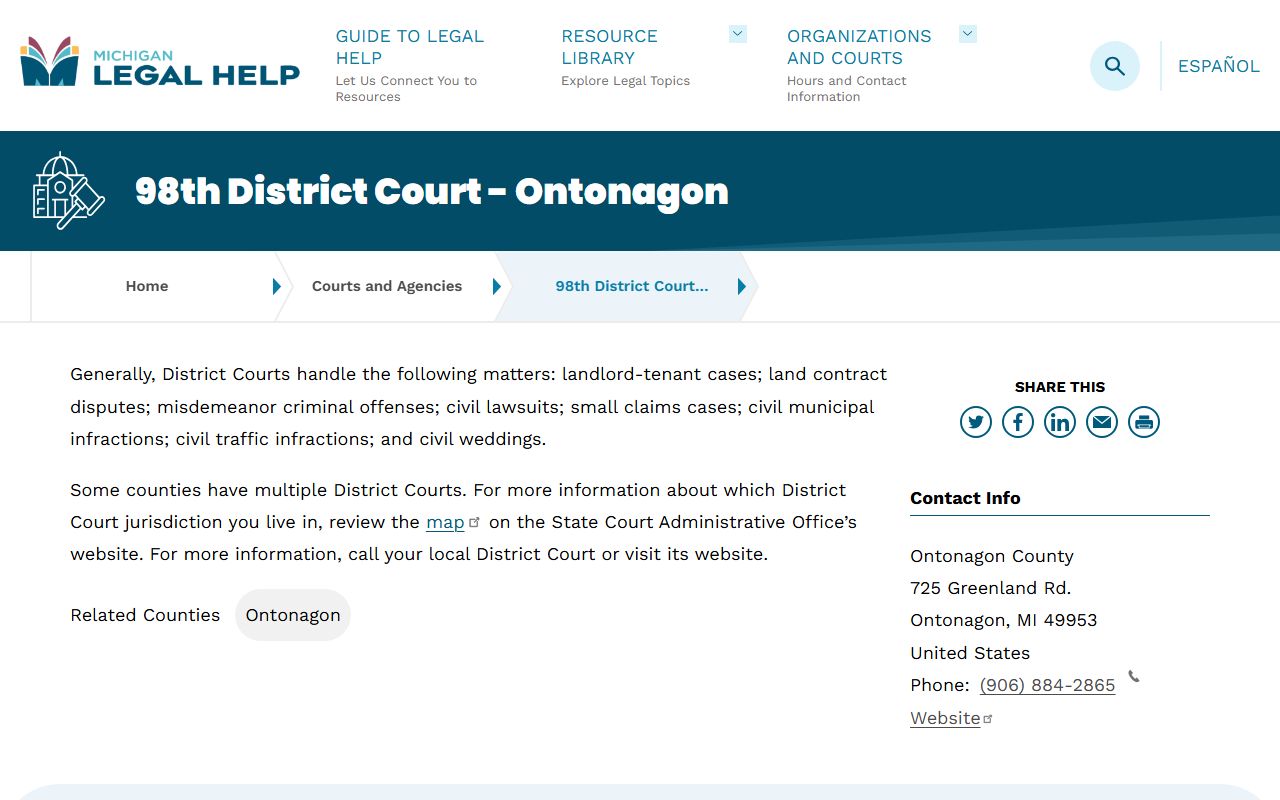
The 98th District Court is where most Ontonagon County charges are first filed and arraigned, which makes it the starting point for many charge searches. When an online result is missing or out of date, the court clerk can confirm the current charges by phone at 906-884-2865, while circuit felony questions run through the County Clerk at 906-884-4699.
How Ontonagon County Charges Get Filed
The charge record starts when a charging document is filed. In Michigan that document is usually a complaint. An officer or the prosecutor signs a sworn complaint that lists each offense and the statute it violates, and the court uses it to open the case. Felonies begin by complaint in District Court, and after the defendant is bound over, the prosecutor files an information in Circuit Court. A grand jury indictment is allowed but rare in Michigan, reserved for a narrow set of serious matters. The three documents share one job: each one turns an arrest into a formal charge on the court file.
The office that makes the charging decision is the county prosecutor, and the Ontonagon County Prosecutor page lists the prosecuting attorney and the office contact.
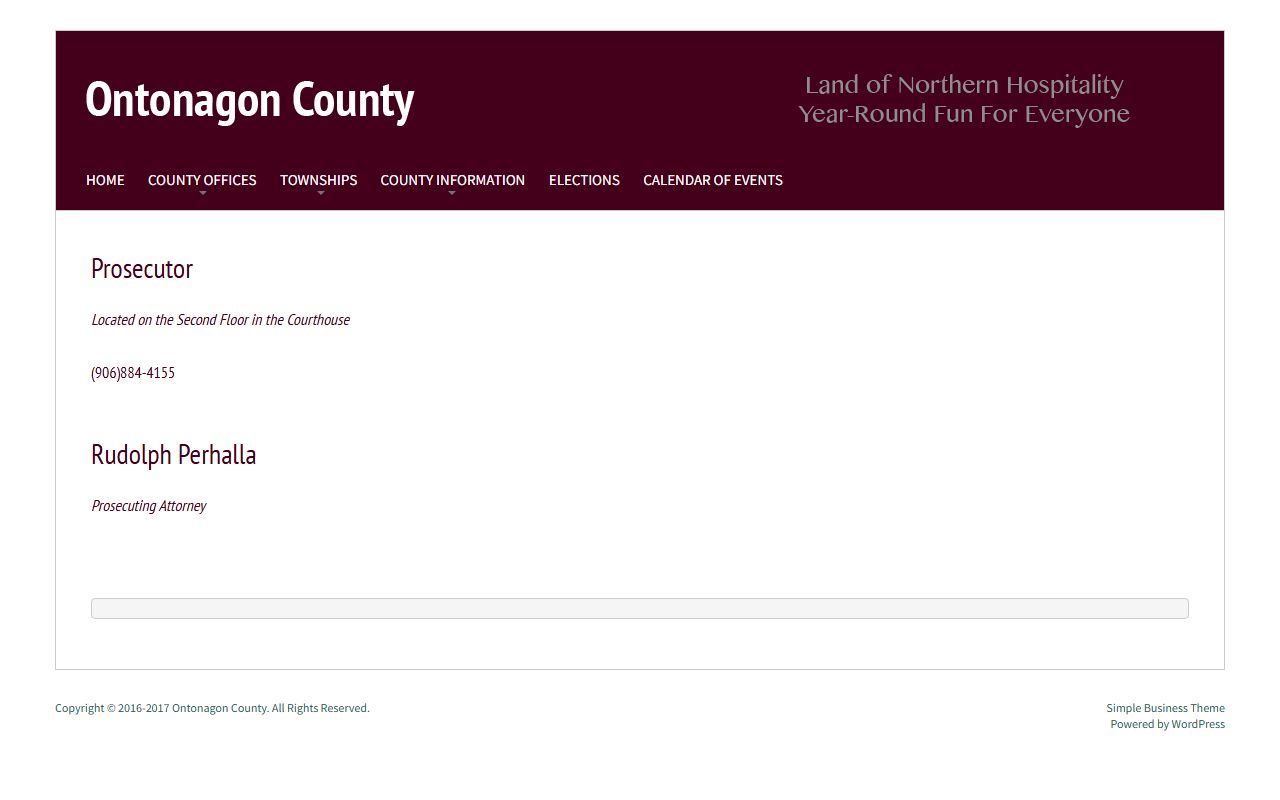
Prosecuting Attorney Rudolph Perhalla, reached at 906-884-4155, is the official who reviews each arrest referral and decides which charges to file with the court.
| Complaint | Information | Indictment | |
|---|---|---|---|
| Filed By | Officer or prosecutor | Prosecutor | Grand jury |
| Court Stage | District Court start | Circuit Court after bindover | Circuit Court |
| Common For | Misdemeanors and felony start | Bound-over felonies | Rare serious felonies |
| Starts the Case | Yes | Follows bindover | Yes |
For a felony, the charge moves through the 98th District Court before it reaches the circuit level. The prosecutor files the complaint, and the court issues a warrant or a summons. At arraignment the defendant hears the charges and a bond is set. Next comes a probable cause conference, an early meeting meant to narrow or settle the case, and then a preliminary examination where a judge decides whether the evidence supports a bindover. If the charge is bound over, it continues in the 32nd Circuit Court on the prosecutor's information. Misdemeanors stay in District Court through plea, trial, and sentencing.
Probable cause conference: an early District Court meeting to narrow or settle a felony before the exam. Preliminary examination: a hearing where a judge decides if the evidence supports sending the case up to Circuit Court. Bindover: the transfer of a felony from District Court to Circuit Court. Information: the charging document the prosecutor files in Circuit Court after bindover.
Ontonagon County Charge Status Explained
Charges rarely stay frozen. As a case develops, the prosecutor may add, amend, reduce, or drop counts, and the judge may dismiss a charge for legal reasons. The status shown in the case record tracks these moves, so a reader can see whether a charge is still active, was lowered, or ended without a conviction. Reading status correctly matters, because a dismissed or reduced charge is very different from a conviction.
| Status | What It Means |
|---|---|
| Pending | The charge is filed and active while the case moves through the court. |
| Amended | The prosecutor changed the wording or the count, often to fit the evidence. |
| Reduced | A charge was lowered to a less serious offense, such as a felony dropped to a misdemeanor. |
| Dismissed | The charge was dropped by the court or the prosecutor and is no longer pursued. |
| Nolle Prosequi | A formal notice that the prosecutor will not go forward on that charge. |
| Bound Over | A felony charge was sent from District Court to Circuit Court after a finding of probable cause. |
Note: A dropped or dismissed charge can still appear in the public court file even though it never became a conviction.
Charges vs. Convictions in Ontonagon County
Being charged is not the same as being convicted. A charge is an accusation that rests on probable cause, the low standard needed to start a case. A conviction requires proof beyond a reasonable doubt, entered by a guilty plea or by a verdict. Both the charge and the later conviction can appear in the public record, so a search may show an open charge, a dismissal, or a final conviction depending on where the case stands.
Michigan Legal Help publishes a 32nd Circuit Court page that outlines how felony charges are handled once they reach the circuit level.
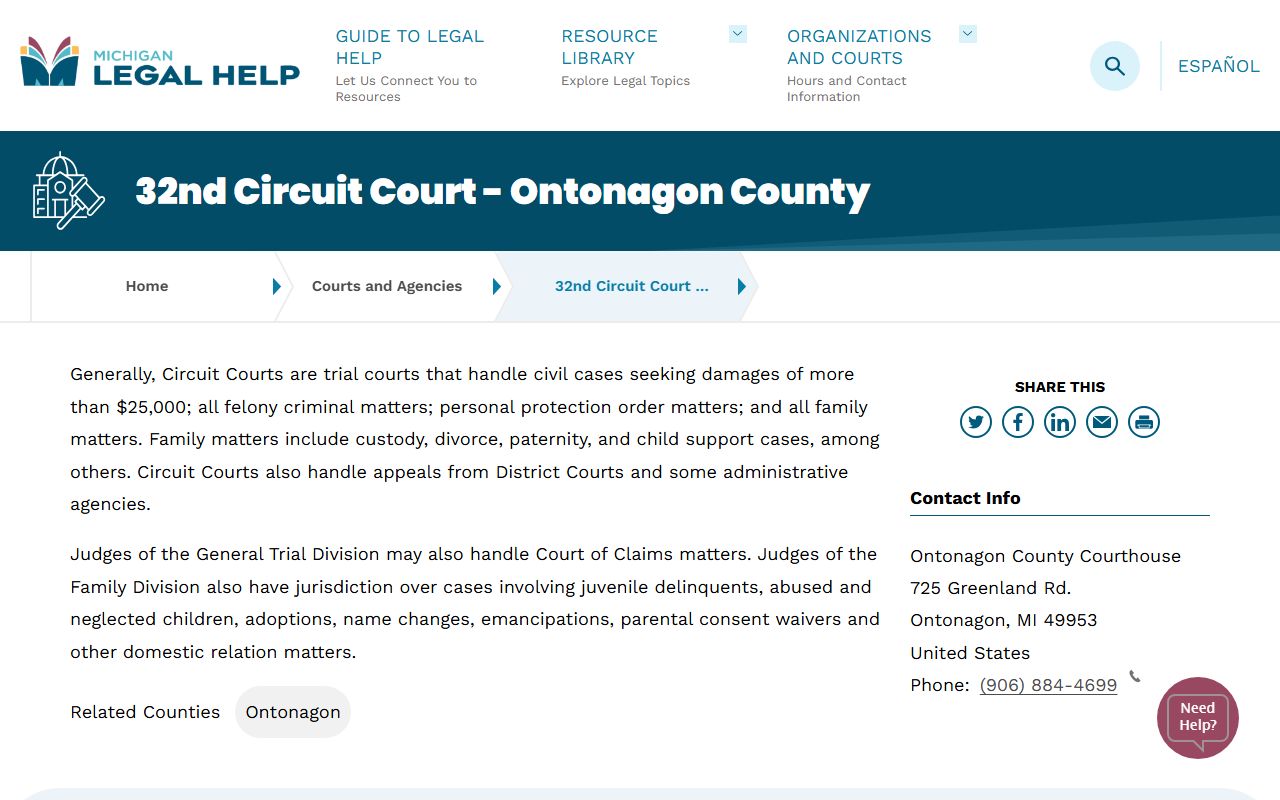
Felony charges filed after an Ontonagon County arrest are tried in the 32nd Circuit Court, and only a plea or a verdict there turns a charge into a conviction.
| Charge | Conviction | |
|---|---|---|
| Stage | Accusation | Plea or verdict |
| Burden of Proof | Probable cause | Beyond a reasonable doubt |
| Decided By | Prosecutor's filing | Judge or jury |
| Public Record | Yes | Yes |
Sealed vs. Expunged Ontonagon County Records
Some charge records are removed from public view. Michigan uses the term set aside for expungement-style relief, and its Clean Slate reforms took effect on April 11, 2021. Eligible convictions can be set aside by application, and some are cleared automatically, which limits what shows in a public criminal history. A sealed record is hidden but still exists in a restricted form. An expunged or set-aside record is treated as though the conviction never happened for most public purposes.
| Sealed | Expunged | |
|---|---|---|
| Visibility | Hidden from public view | Treated as never existed |
| Law Enforcement | Limited access | Very limited access |
| Eligibility | By court order in specific cases | Set aside under MCL 780.621 and Clean Slate |
Ontonagon County Charge Codes and Severity
Each charge is tied to a specific statute, and the code in the record points to the exact law alleged. Michigan sorts offenses into three broad levels. Felonies carry possible prison time. Misdemeanors carry up to a year, or up to two years for a high-court misdemeanor. Civil infractions are non-criminal violations that bring fines rather than jail. A single Ontonagon County arrest can generate several separate charges, each with its own code, level, and status. The severity level drives where the case is heard and whether the charge can later be set aside.
Statewide Charge and Criminal History Lookups
Charges that end in certain convictions roll up into a statewide criminal history. The Michigan State Police runs ICHAT, the Internet Criminal History Access Tool, for public name-based searches. ICHAT covers felonies and serious misdemeanors punishable by more than 93 days that agencies must report from all 83 counties. It leaves out warrants, traffic, juvenile, local misdemeanors, federal, tribal, and out-of-state records, so a fresh Ontonagon County charge can appear in the court file well before it shows in ICHAT. For people under state supervision after a conviction, the MDOC OTIS system is a separate search.
Note: A current warrant never appears in ICHAT, so it cannot be used to check for an active Ontonagon County warrant.
Background Checks and Ontonagon County Charges
A casual name search is not the same as a formal background check. Employers, landlords, and licensing bodies that use screening reports must follow the federal Fair Credit Reporting Act, which sets accuracy and permission rules. A quick look at a court charge record can be wrong or out of date, since charges get amended, reduced, or dismissed after the first filing. For any regulated decision, the safe path is a compliant screening service that verifies charges against the current court record.
Important: This site is a public-records resource, not a consumer reporting agency under the FCRA, and its information cannot be used for credit, employment, tenant, or insurance screening.
Restricted Charge Records in Ontonagon County
Not every charge is open to the public. Juvenile charges are restricted under Michigan law and the state's nonpublic record rules, so most juvenile files are closed to general viewing. Set-aside convictions, sealed matters, adoption cases, and mental-health proceedings are also withheld or limited. Charges tied to an active investigation may be held back until the case is filed or resolved. Court case records themselves are governed by Michigan Court Rule 8.119. When a record is not visible online, that does not always mean no charge exists, and the court clerk can confirm what is public.