
What Is a Court Docket or Register of Actions
A court docket is the official index of everything filed and decided in a single case. Michigan courts usually call it the register of actions. Each line marks one event, dated in the order it happened. The docket shows the case number, the parties, the assigned judge or magistrate, and every step from the first complaint or citation to the final order. It is the quickest way to see where a case stands without pulling the entire paper file.
The list of entries can grow long. A single circuit or district case may record the complaint filed, the summons issued, an answer, an arraignment, pretrial conferences, motions, hearing notices, orders entered, a judgment or disposition, sentencing, probation reviews, payments, and any appeal. Probate, family, and traffic dockets follow the same pattern with different event names. A financial section may track fines, costs, restitution, bond, and the balance still owed. Hearing entries list the date, time, courtroom, and result once the court records it.
The docket is a summary of events, not the evidence behind them. It tells you that a motion was filed, not what the motion argued.
Note: A docket entry proves an event happened, but the document image behind that entry is usually not attached to the online view.
How to Find Ontonagon County Dockets Online
Ontonagon County does not run its own docket website. The main public tool is MiCOURT Case Search, the Michigan Courts case-information portal. It notes that civil, traffic, criminal, domestic and family, and probate cases may appear depending on the court selected. Coverage is not the same for every court, so a name that returns nothing online can still have an open file at the courthouse. Start with the portal, then confirm with the clerk.
- Open the MiCOURT Case Search portal from the Michigan Courts website.
- Choose the court that heard the case, such as the 32nd Circuit Court, the 98th District Court, or the Ontonagon County Probate Court, if it is listed.
- Search by the full case number when you have it, or by last name and first name for a party search.
- Open the matching case to view its register of actions, then read each dated entry from the first filing through the disposition.
If the search comes back empty, the court may not post that case type online, or the record may be restricted. Older files, sealed matters, and cases from courts that do not participate in the portal often need a direct call to the clerk.
What an Ontonagon County Docket Entry Shows
A public case result on MiCOURT is built from a set of standard fields. Michigan court records follow MCR 8.119, so the same categories appear across circuit, district, and probate dockets even when the event names differ. The table below maps the register-of-actions fields a reader is likely to see and what each one tells you about the case.
| Field | What It Shows |
|---|---|
| Case Number | The court-assigned number, usually a year plus a two-letter case-type code. |
| Court | The 32nd Circuit Court, 98th District Court, or Ontonagon County Probate Court. |
| Case Type | Criminal, civil, domestic, probate, traffic, landlord-tenant, or small claims. |
| Filing Date | The date the complaint, petition, citation, or bindover was filed. |
| Parties | Plaintiff and defendant, petitioner and respondent, or estate and protected person. |
| Attorneys | Attorneys of record once they file an appearance in the case. |
| Judge or Officer | The judge, magistrate, or probate judge assigned to the matter. |
| Register Entries | Each filing, hearing, order, judgment, disposition, and notice, listed by date. |
| Financial Section | Fines, costs, restitution, bond, filing fees, and any remaining balance due. |
| Hearing Schedule | Date, time, courtroom, hearing type, and result when the court enters it. |
| Documents | Listed as events only; document images are restricted, so copies come from the clerk. |
| Restrictions | Redacted personal data, juvenile detail, sealed matters, and other nonpublic items. |
Not every field appears in every case. A short civil-infraction docket may carry only a citation, a plea, and a fine, while a felony docket runs through dozens of entries across two courts.
Reading Ontonagon County Case Numbers
Michigan case numbers are not random. They usually combine the filing year with a two-letter case-type code that names the kind of case. Michigan Legal Help explains that the case-type code sits at the end of a court case number. Reading that code first tells you which court and division owns the docket, which saves a search or two before you ever type a name. The state's case-type-code guide breaks down where the code sits and what the common letters mean.
Anyone comparing several files at once can use the guide as a quick reference for reading Ontonagon County dockets.
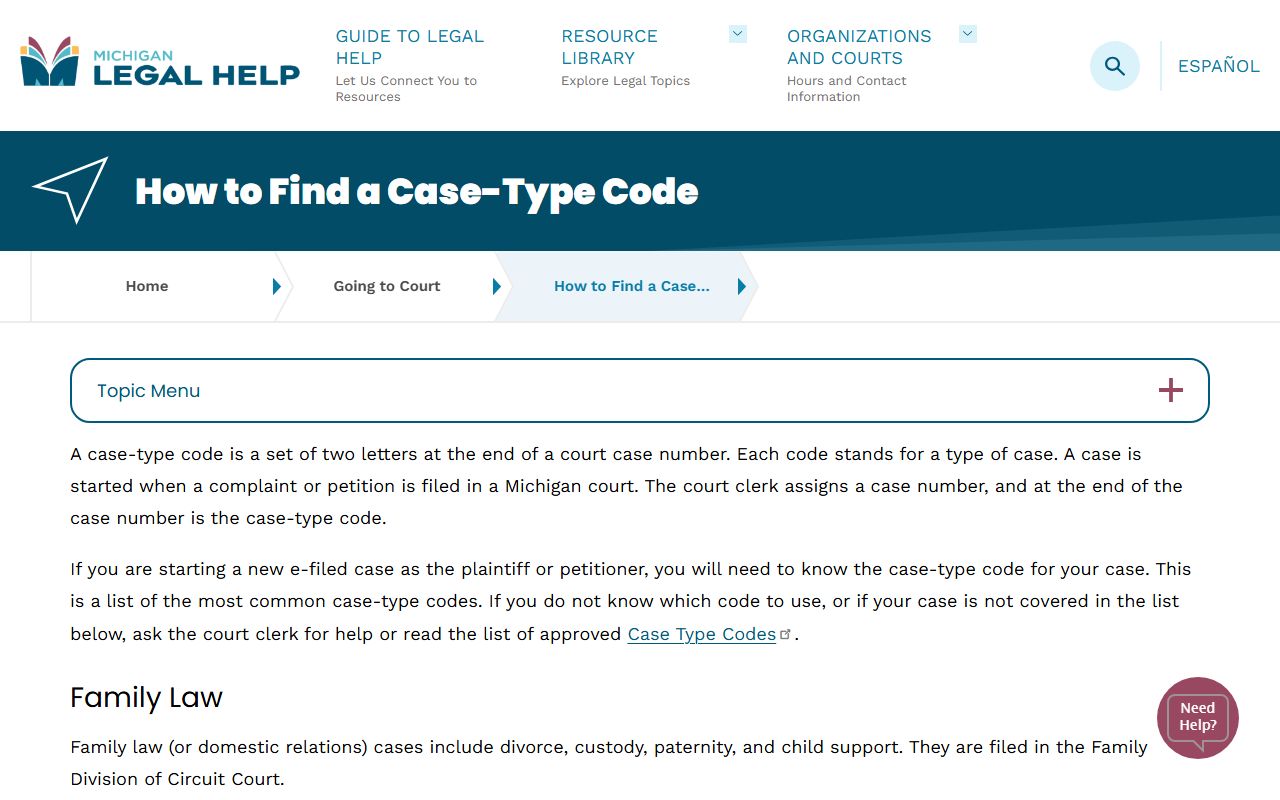
Matching the code to the right court is the first move in any Ontonagon County docket search, because the same person can appear in criminal, civil, family, and probate files under different case-type codes.
Family Division Case Codes in Ontonagon County
Family records carry the most codes, and the local plan spells them out. The 2025 32nd Circuit family court plan for Gogebic and Ontonagon Counties lists dozens of two-letter categories that route family and juvenile cases between the circuit judge and the probate judge. That is why a family docket can look cryptic at first glance. The groups below cover the codes a reader is most likely to meet in Ontonagon County dockets.
| Code Group | What the Code Signals |
|---|---|
| DM, DO, DP, DC, DS, DZ | Domestic relations cases, including divorce, support, and paternity. |
| NA | Child neglect or abuse petitions in the juvenile docket. |
| DJ, DL, JG | Juvenile code delinquency and juvenile guardianship matters. |
| AB, AC, AD, AM | Adoption cases, which are confidential by statute. |
| EE, EP, ER, EV | Extreme risk protection order matters assigned to the circuit judge. |
In Ontonagon County, the probate judge serves as presiding family division judge and is assigned juvenile, adoption, and many family miscellaneous matters, while the circuit judge takes extreme risk protection order cases. A family docket may therefore sit in the probate side of the courthouse even though the case reads as a circuit family matter.
Courts That Hold Ontonagon County Dockets
Three trial courts share the Ontonagon County Courthouse, and each keeps its own dockets. Picking the right one before searching matters because a felony, a divorce, and an estate never sit in the same register of actions. The list below shows what each court handles.
- 32nd Circuit Court: felonies, civil cases over $25,000, divorce, custody, personal protection orders, and appeals from the District Court.
- 98th District Court: misdemeanors, traffic and civil infractions, landlord-tenant cases, small claims, and the preliminary stages of felony matters.
- Ontonagon County Probate Court: estates, wills, guardianships, conservatorships, and assigned juvenile and adoption matters.
The Friend of the Court handles child support, custody, and parenting-time enforcement tied to family cases, but those files are not open public dockets. The county's Circuit Court and District Court pages list the judges and phone lines for each court. The 32nd Circuit and 98th District serve both Gogebic and Ontonagon Counties, so choose the county where the case was actually filed when a portal asks.
Ontonagon District Court Dockets in Michigan ePAY
Some district traffic and misdemeanor cases surface through Michigan ePAY, a statewide payment and lookup service. The 98th District Court page directs users to pay fines online with a debit or credit card, and the state ePAY system adds a search interface for courts that participate. Because not every court and payment type joins the same system, it helps to check both the local District Court page and the statewide tool. The Michigan Courts ePAY site is the front door for that service.
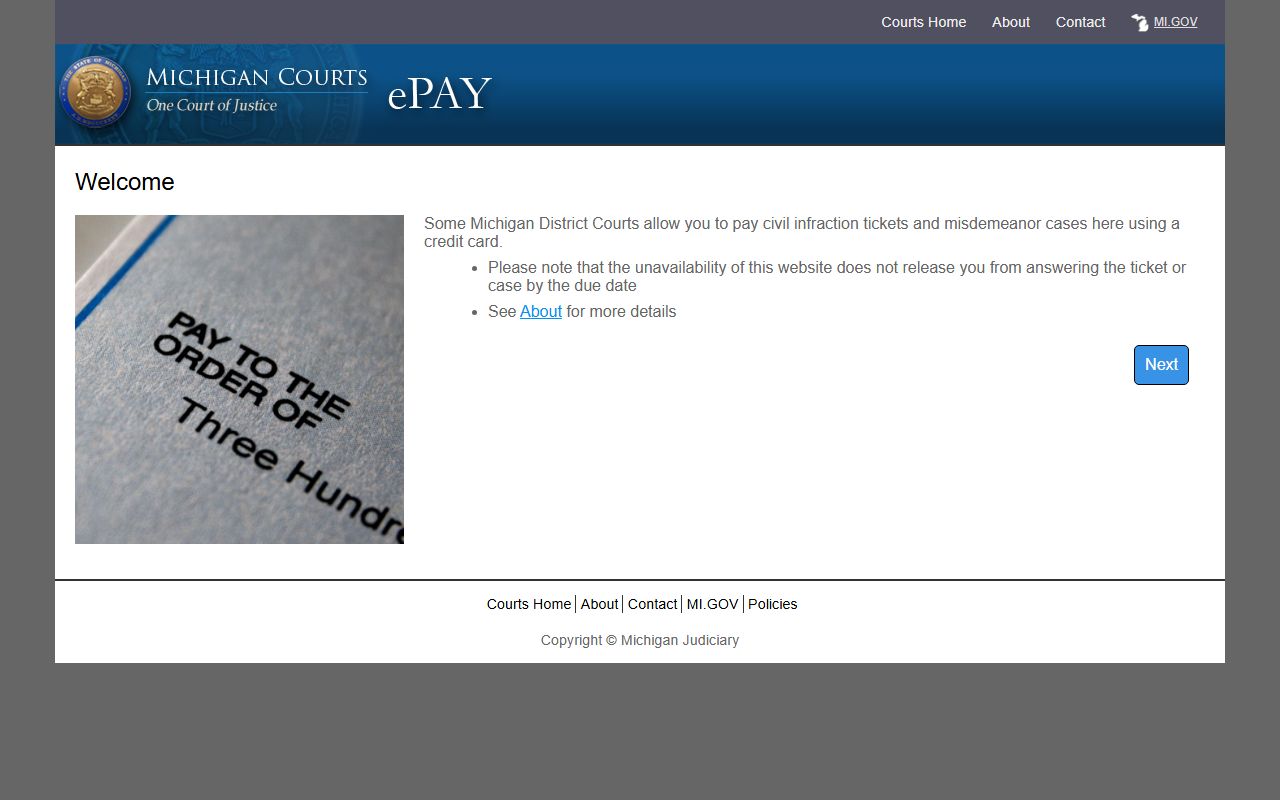
From the ePAY home page, the ticket and case search lets a driver look up a citation before paying or contesting it. The ePAY ticket and case search accepts a last name with a ticket or case number, a last name with a date of birth, a driver's license number, or a license plate number.
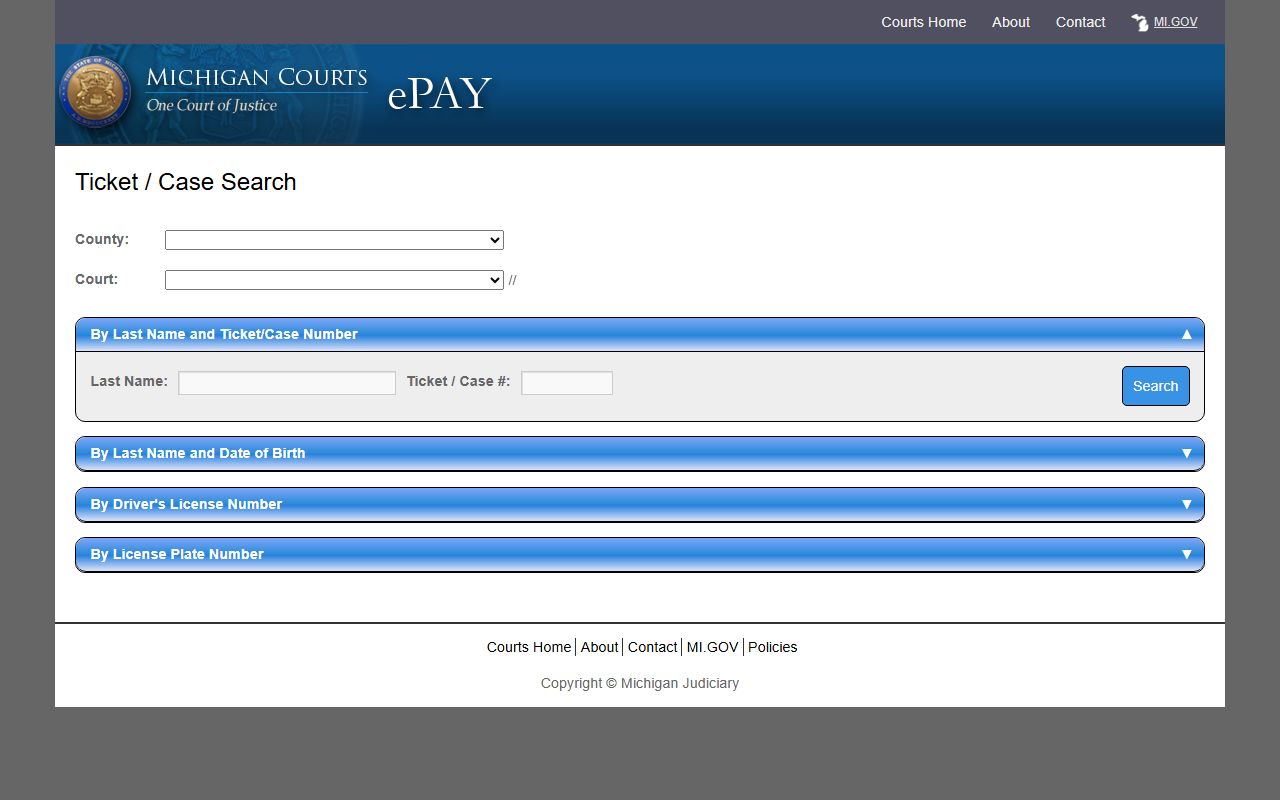
ePAY is a payment and citation tool, not a full docket archive, so it works best for open traffic tickets. The deeper filing history for those cases still lives in the district court file, and driver-license consequences appear on the separate state driving record. More detail on citation lookups sits on the Ontonagon County traffic court records page.
Federal and Bankruptcy Dockets for Ontonagon County
Not every case from Ontonagon County is a state matter. The county sits in the U.S. District Court for the Western District of Michigan, in the Northern Division, with the closest federal court location in Marquette. Federal criminal, civil rights, and federal-question cases route there, and their dockets run through the court's own CM/ECF system rather than MiCOURT. Bankruptcy is separate again and belongs to the U.S. Bankruptcy Court for the Western District of Michigan. The bankruptcy court's CM/ECF case information page explains how PACER access works.
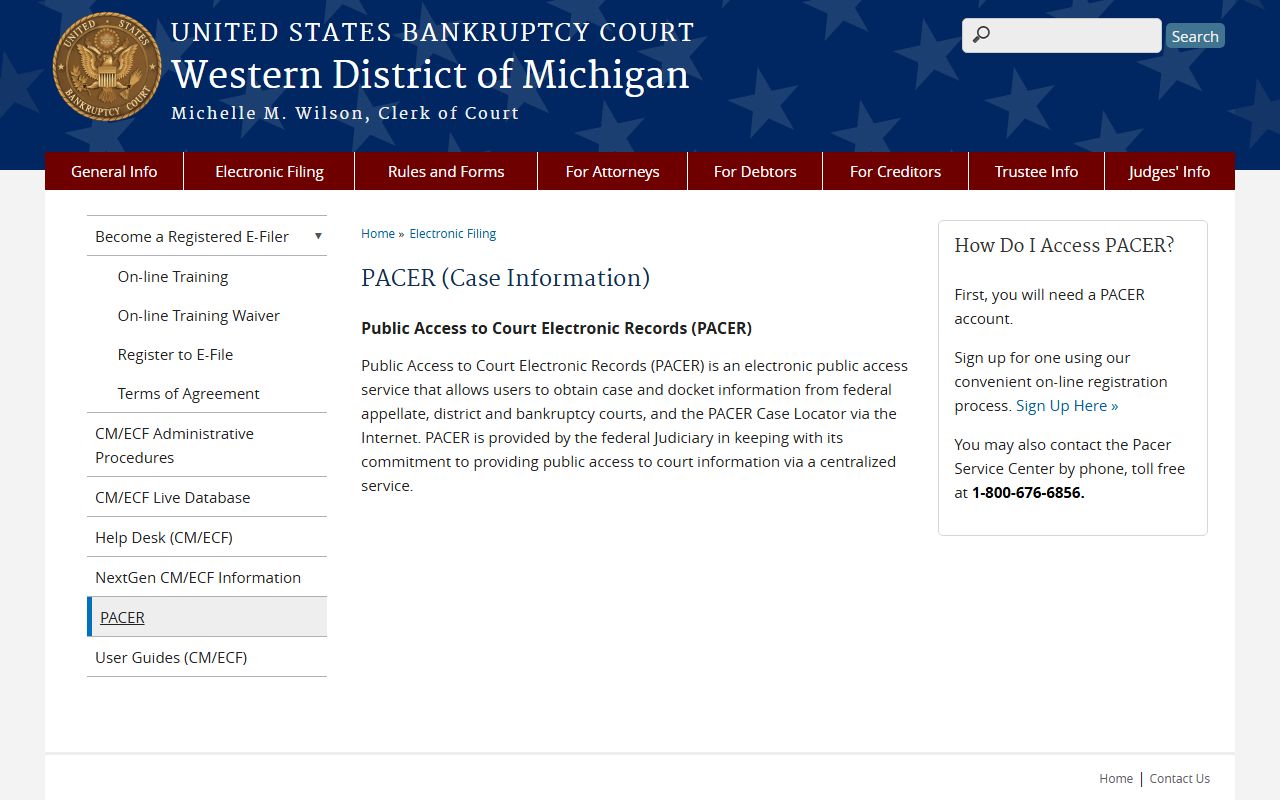
PACER is the official electronic public access service for federal district, appellate, and bankruptcy dockets. It requires registration and may charge per-page fees unless an exemption or the quarterly threshold applies. A state case search on MiCOURT will never show a federal docket, so anyone tracking a bankruptcy or federal case has to use the federal system directly.
Docket vs. Full Case Record in Ontonagon County
The docket and the full case record are not the same thing, and the gap between them trips up many searchers. The docket is the list of events. The full record is the stack of documents behind those events: the motions, orders, exhibits, and judgments themselves. Michigan Courts records-management guidance states that courts are prohibited from posting document images on the internet under MCR 8.119(H), even when the docket entry is public. The images are available at courthouse terminals or through the clerk, not through the online search.
| Docket | Full Case Record | |
|---|---|---|
| Format | Dated list of entries | Full document images |
| Access | Often online and free | Clerk copy or courthouse visit |
| Use | Track case progress | Legal review and evidence |
| Cost | No fee to view online | Copy and certification fees apply |
For a certified copy, an older file, or any document not visible online, the fix is to contact the clerk of the court that owns the case. The full case file and its documents are covered on the Ontonagon County court records page, which walks through certified-copy requests in more detail.
Why Some Ontonagon County Docket Entries Disappear
A blank or thin docket does not always mean a case never existed. Michigan law suppresses whole categories of records from public online view, and a court may hold a case internally that the portal will not show. Understanding the main reasons keeps a searcher from assuming the online result is the full story.
Michigan uses the phrase set aside for expungement-style relief. Under MCL 780.621 and the Clean Slate law that expanded eligibility in 2021, qualifying convictions can be set aside by application or automatically, which removes them from public criminal-history visibility. Juvenile records are restricted under MCL 712A.28 and open only as the statute and court rules allow. Adoption and mental-health records carry their own confidentiality rules and are not ordinary public files.
Sealed matters, protected personal identifying information, minor names, and certain family details are redacted or withheld by court rule. A record that is set aside or sealed should not appear as an ordinary public docket, even though the court and law-enforcement agencies may keep nonpublic access.
Note: A missing entry can mean the court does not post that case type online, not that the case was dismissed or sealed, so confirm with the clerk before drawing a conclusion.
Calling the Correct Ontonagon County Court
When the online docket is blank, incomplete, or older than the portal's coverage, a phone call to the court that owns the file is the fastest fallback. All three trial courts share the courthouse at 725 Greenland Road, and their public hours run 8:30 a.m. to 4:30 p.m. Have the party name, case number, and case type ready before calling so the clerk can find the docket quickly.
Match the call to the case type. Felony, divorce, custody, and protection-order dockets belong to the 32nd Circuit Court at 906-884-4699, and the County Clerk handles many circuit records at 906-884-4255. Misdemeanor, traffic, landlord-tenant, and small-claims dockets belong to the 98th District Court at 906-884-2865. Estate, guardianship, and conservatorship dockets go to the Probate Register at 906-884-4117.
Can I see the actual documents listed on a docket? Usually not online. Michigan court rules keep document images off the public internet, so the docket names the event while the clerk holds the file. Ask the court for a copy or a certified copy of the document you need.
Why does a case show nothing online? The court may not post that case type through the portal, the record may be sealed or set aside, or the matter may be juvenile, adoption, or mental-health related and closed to public search.
Because the clerk, register of deeds, and Friend of the Court offices stay open through the lunch hour while other offices close from noon to 1 p.m., timing a call or visit around that gap can save a wasted trip to the second-floor courtrooms.