
Checking for a Warrant in Ontonagon County
The county does not run a web page where a person can type a name and see active warrants. Instead, warrant information stays with the office that created or serves the warrant. For most people, the first call goes to the Ontonagon County Sheriff's Department at 906-884-4901. Deputies can explain how the county confirms a warrant and what a person should do next. Have the full legal name, a date of birth, and any case or citation number ready before calling.
The right office depends on the kind of case. Bench warrants tied to traffic tickets, civil infractions, misdemeanors, and the early stage of a felony come out of the 98th District Court. Felony, probation, personal protection order, and family contempt warrants tend to come from the 32nd Circuit Court, whose records run through the County Clerk. The Prosecutor's Office can answer questions about how a charge became a warrant, though it does not clear warrants itself.
Because the county is small and its courts sit in one courthouse, a phone call is often the reliable path. Start with the office most likely to hold the case, and be ready to be routed to another counter within the same building.
- Sheriff's Department, 906-884-4901 - custody and warrant-confirmation questions.
- 98th District Court, 906-884-2865 - bench, traffic, misdemeanor, and preliminary-felony warrants.
- 32nd Circuit Court, 906-884-4699, or County Clerk, 906-884-4255 - felony, probation, PPO, and family contempt warrants.
- Prosecutor's Office, 906-884-4155 - process questions about how charges become warrants.
The department keeps a short public listing rather than a searchable roster. The Ontonagon County Sheriff Department page gives the address and phone that these warrant calls use.
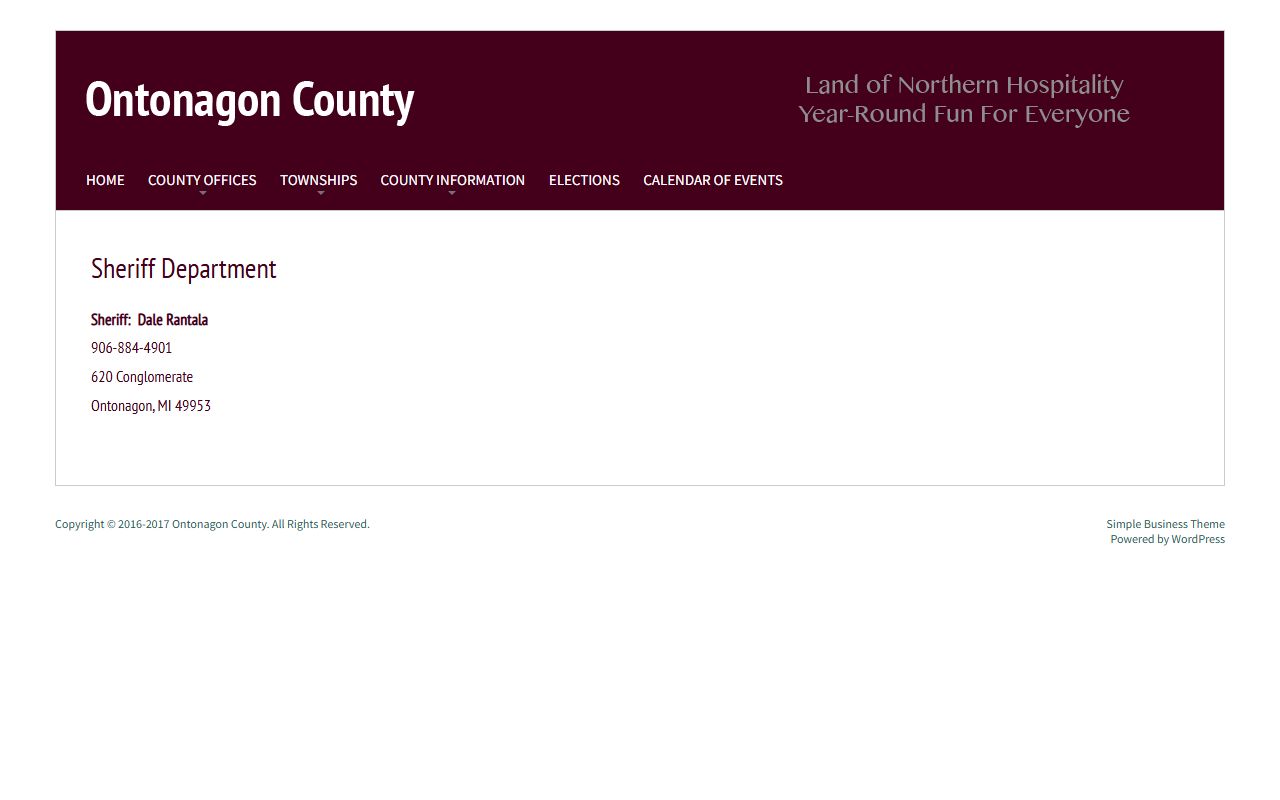
Because that page is a contact listing and not an active-warrant database, the phone number on it is the working tool for any Ontonagon County warrant question.
Types of Warrants in Ontonagon County
Warrants are not all the same, and the type shapes who to contact and how to clear it. A bench warrant and an arrest warrant are the two people ask about most, but several other kinds move through the county courts. Each one starts with a judge and ends with law enforcement or the court that issued it.
- Arrest warrant - issued after a prosecutor-approved complaint and a judge's finding, authorizing police to take a person into custody.
- Bench warrant - issued by a judge after a missed hearing, an unpaid fine, or a failure to follow a court order.
- Probation-violation warrant - issued when a person breaks the terms of court-ordered supervision.
- Contempt warrant - issued for defying a court order, common in family and support matters.
- Search warrant - authorizes a search of a place or property and is usually not public before it is carried out.
- Fugitive warrant - used to hold a person wanted in another county or state.
- Child-support or civil-enforcement warrant - issued to compel compliance in a support or civil matter.
Note: The same failure, such as missing a hearing, can trigger a bench warrant in either the district or circuit court depending on the underlying case.
How to Check for an Ontonagon County Warrant
A warrant check moves fastest when the caller knows the likely court and has identifying details in hand. There is no self-service portal, so the work is a short sequence of calls and questions rather than a database search. The order below keeps the process focused.
- Identify the likely court by case type: the 98th District Court for traffic, misdemeanor, and preliminary-felony matters, and the 32nd Circuit Court for felony, probation, PPO, and family contempt.
- Gather the person's full legal name, date of birth, and any case, citation, or warrant number.
- Call the Sheriff's Department at 906-884-4901 or the issuing court directly.
- Ask whether an active warrant exists and what it will take to resolve it.
- If a case appears on MiCOURT Case Search, note the case number and status, then confirm the warrant detail with the office.
Ontonagon County Warrant Search Fields
There is no county warrant portal with search boxes, so the fields that matter are the identifying details a caller or the court uses to find a record. The free MiCOURT Case Search can show a related court case, though it is not a live warrant database and may not display active warrant status.
| Field Label | Type | Required | Notes |
|---|---|---|---|
| Online active warrant search | Web tool | Not available | No official Ontonagon County warrant search located. |
| Full name | Caller-provided | Yes | Primary identifier for a phone or counter check. |
| Date of birth | Caller-provided | Recommended | Helps separate people with similar names. |
| Case or citation number | Caller-provided | If known | Speeds a court lookup. |
| Warrant number | Caller-provided | If known | Gives an exact match when available. |
| MiCOURT court and case search | Online fields | Optional | Search by name or case number; may not show active warrant status. |
MiCOURT and ICHAT Warrant Limits
Two statewide tools come up often, and neither is a warrant search. MiCOURT Case Search can display a public case, its hearing history, any defaults, and its docket entries, which sometimes hint that a bench warrant was issued. It does not promise a real-time warrant status, and a clear MiCOURT screen does not prove that no warrant exists.
The Michigan State Police ICHAT criminal-history search is not a warrant tool either. Its own guidance states that warrant information is not included, along with suppressed, federal, tribal, juvenile, traffic, and out-of-state records. A person cannot use ICHAT to learn whether a warrant is active.
Note: A charge can appear in court records before it reaches ICHAT, and an active warrant will not show in ICHAT at all.
What an Ontonagon County Warrant Record Shows
When the sheriff or the court confirms a warrant, the record behind it holds a standard set of fields. Not every field is public, but the list below shows what a full warrant entry contains and why each field matters when a person tries to resolve it.
| Field | What It Shows |
|---|---|
| Warrant number | The unique identifier assigned to the warrant. |
| Name and identifiers | Full legal name and details used to confirm identity. |
| Issuing court | The 98th District, the 32nd Circuit, or a family assignment. |
| Case number | Links the warrant to its underlying court case. |
| Charge or reason | The offense or the failure that prompted the warrant. |
| Warrant type | Arrest, bench, probation, contempt, search, fugitive, or civil enforcement. |
| Issue date | When the judge signed the warrant. |
| Bond amount or status | The bond set, or a no-bond hold. |
| Served or return status | Whether the warrant is still open. |
| Next court date | The hearing set after arrest or surrender. |
Once a warrant leads to an active case, the charges and outcomes become part of the county criminal court records, which hold the fuller case file.
How to Resolve an Outstanding Warrant
An outstanding warrant does not go away on its own, and it can lead to an arrest during a routine traffic stop. Handling it deliberately, with the right office and often a lawyer, gives a person the most control over the outcome. The steps below follow the practical order used for an Ontonagon County warrant.
- Do not rely on ICHAT to confirm the warrant, since state guidance says warrant information is not included there.
- Identify the issuing court by case type: the 98th District for traffic, misdemeanor, or preliminary felony, and the 32nd Circuit for felony, probation, PPO, or family contempt.
- Call the court or the Sheriff's Department using the official phone numbers.
- Ask whether a walk-in appearance, bond posting, attorney appearance, payment, or a scheduled hearing is required.
- If a bond applies, confirm accepted payment methods and whether the court's GovPros portal can be used, because paying online does not automatically clear a warrant.
- After an appearance, payment, or recall order, ask when the record updates and whether written proof of clearance is available.
If a warrant leads to an arrest, custody status and booking questions route to the sheriff, and the county inmate records page explains that path in more detail.
Important: Talk to a lawyer before turning yourself in, since an attorney can arrange a surrender, argue bond, and protect your rights at the first hearing.
Federal Warrants and the U.S. Marshals
Not every warrant is a county matter. Federal warrants come from the U.S. District Court for the Western District of Michigan, which places Ontonagon County in its Northern Division. These are handled by federal agencies rather than the county sheriff or the district court, and the closest federal court location for Upper Peninsula matters is Marquette.
The U.S. Marshals Service serves federal warrants and runs fugitive operations for the district, with a Marquette office covering Upper Peninsula cases. Federal charging decisions come from the U.S. Attorney's Office for the Western District of Michigan, whose main office sits in Grand Rapids.
Background on the district, its divisions, and its leadership sits on the U.S. Attorney Western District of Michigan page.
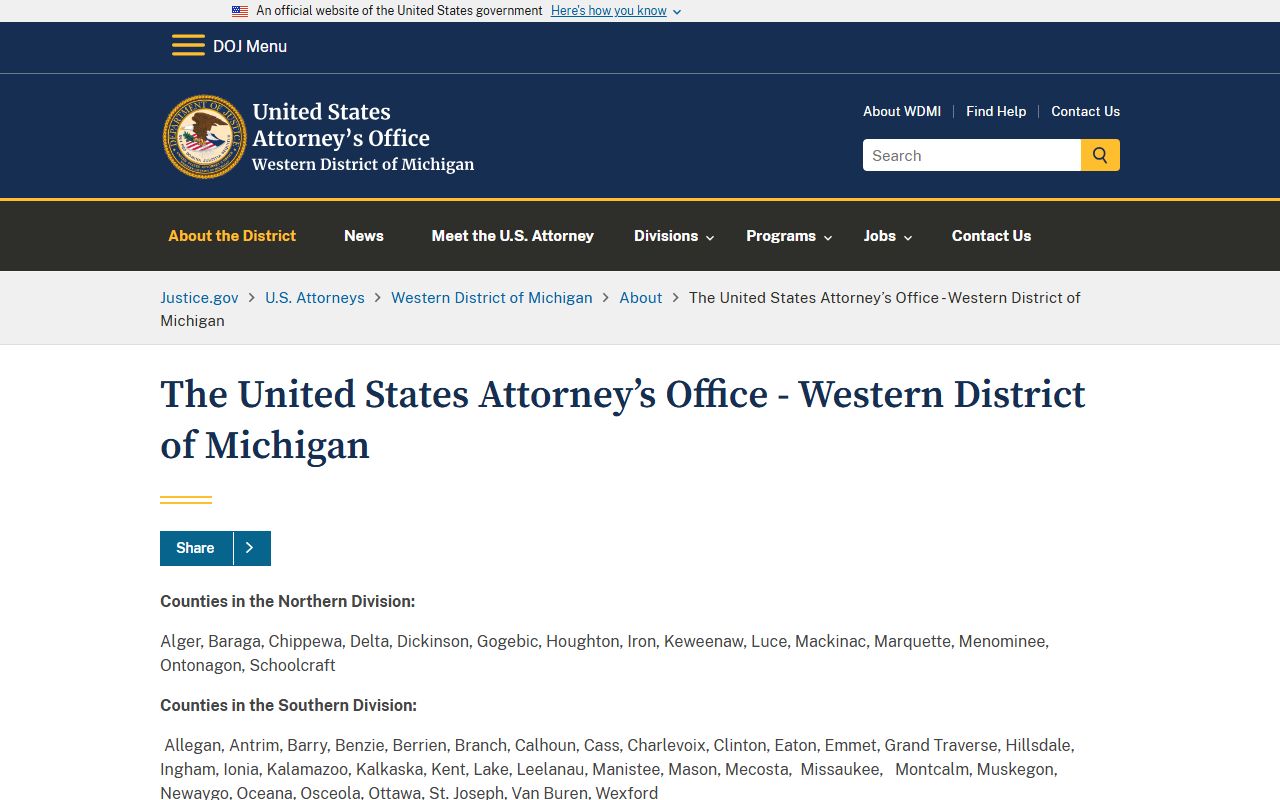
That office decides which cases become federal prosecutions, while the Marshals carry out the arrests behind federal warrants, keeping them fully separate from an Ontonagon County court warrant.
Restricted and Sealed Warrant Records
Some warrants are not open to the public. Search-warrant affidavits are often sealed before, and sometimes after, they are carried out, especially while an investigation continues. Warrants tied to juvenile cases follow the confidentiality rules that cover juvenile records, so they are not treated like ordinary adult warrants.
Public-records requests can reach some warrant information, but active warrants, sealed matters, and law-enforcement-sensitive records often stay closed. The sheriff or the issuing court decides what can be released, and a request may be denied to protect an ongoing case or a person's safety.