
Criminal Court Records in Ontonagon County
Once a prosecutor files charges, the court opens a case file and keeps every paper and entry tied to it. That file is the criminal court record. It starts with the charging document and grows with each arraignment, bond order, motion, hearing notice, plea, and order the judge signs. In a misdemeanor case, the whole file usually stays with the 98th District Court. In a felony case, the early file is built in District Court and the main file moves to the 32nd Circuit Court after bindover. The County Clerk / Register of Deeds serves as the clerk for circuit criminal files, while the District Court keeps its own register for misdemeanor and preliminary matters.
Two trial courts hear criminal cases in Ontonagon County. The 98th District Court handles misdemeanors from start to finish and manages the first stage of every felony, including arraignment, bond, the probable cause conference, and the preliminary examination. The 32nd Circuit Court, which Ontonagon shares with Gogebic County, holds all felony matters after a case is bound over from District Court. Both courts sit on the second floor of the Ontonagon County Courthouse at 725 Greenland Road. The charging side of a case is covered in more depth in the Ontonagon arrest records and court charges pages, while the criminal court record is the case-level file that follows the charge through to judgment.
How to Search Ontonagon County Criminal Court Records
The main starting point is MiCOURT Case Search, the statewide Michigan Courts portal that lists case information for participating trial courts. Criminal, traffic, civil, and family case types may appear depending on the court selected. There is no separate Ontonagon-only criminal database, so a searcher selects the correct court, such as the 32nd Circuit Court or the 98th District Court for Ontonagon, and then searches by name or case number. Online case search shows the case-level record, not full document images.
- Open MiCOURT Case Search and pick the Ontonagon court that fits the case, the 32nd Circuit Court for felonies or the 98th District Court for misdemeanors.
- Search by the defendant's last name, or enter the full case number if it is known.
- Narrow the results by court, case type, and filing date to find the right person and matter.
- Open the case to read the register of actions, hearing dates, disposition, and sentence entries.
- Request a certified copy from the clerk that owns the file when a court-ready document is needed.
Statewide criminal-history searches run through a different system. The Michigan State Police keeps a public repository called ICHAT, and the Michigan Department of Corrections runs OTIS for people under state supervision. A closer look at the Michigan State Police criminal-history record service page explains what ICHAT covers and where it stops.
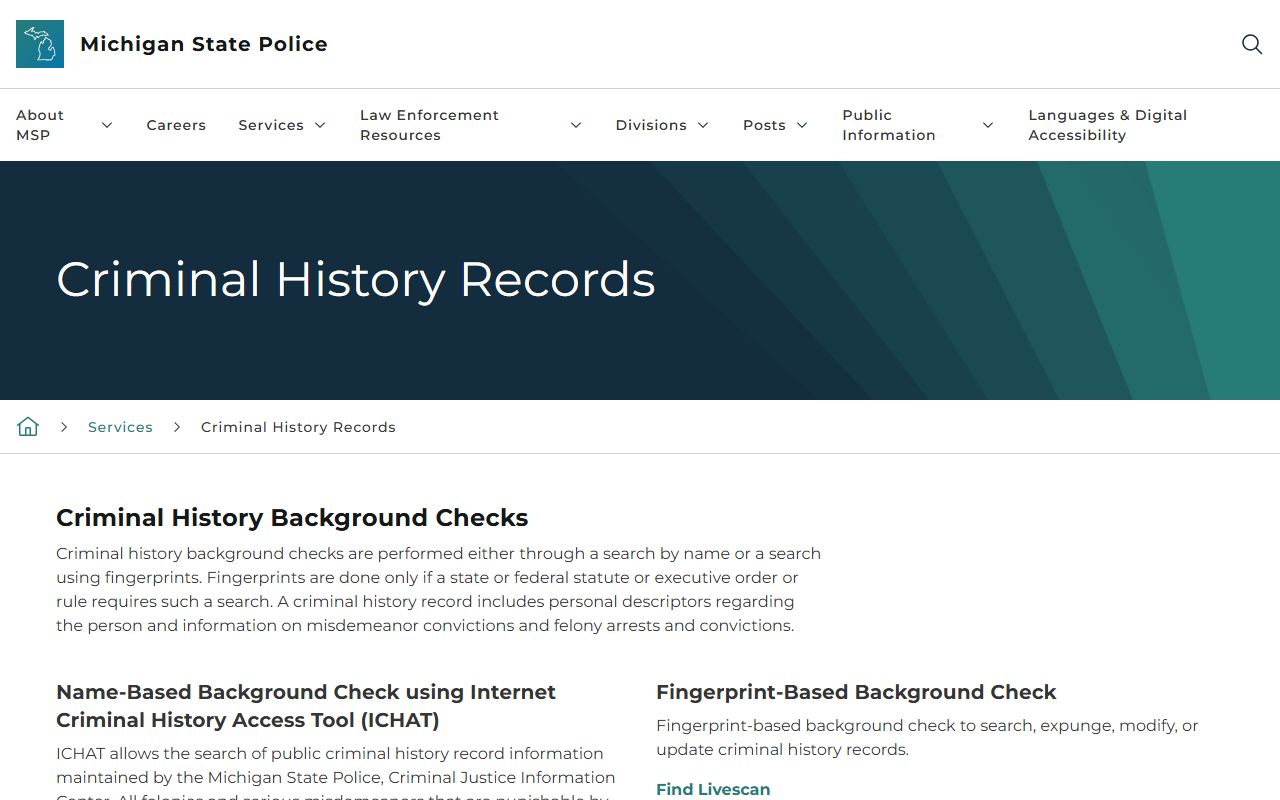
ICHAT is a repository record and not the actual Ontonagon County case file, so it is best used to confirm reportable convictions rather than to read a live docket. For the case itself, MiCOURT and the court clerk remain the better source.
Stages of an Ontonagon County Criminal Case
A Michigan criminal case moves through set stages, and each one leaves a mark in the court record. A felony and a misdemeanor start the same way but split after the early District Court steps. Reading the docket in order shows where a case sits today and what the court has already decided.
Case flow: Charges Filed › Arraignment › Probable Cause Conference › Preliminary Examination › Bindover › Circuit Arraignment › Plea or Trial › Disposition › Sentencing
| Stage | What Happens |
|---|---|
| Charges Filed | The prosecutor reviews a police referral and files a complaint, which opens the case in the 98th District Court. |
| Arraignment | The defendant is told the charges and rights, enters a first plea, and the judge or magistrate sets bond. |
| Probable Cause Conference | A felony-stage District Court hearing where the prosecutor and defense discuss the case before the preliminary examination. |
| Preliminary Examination | A felony hearing to decide if enough proof exists to send the case to Circuit Court. |
| Bindover | The felony is transferred from the 98th District Court to the 32nd Circuit Court for further proceedings. |
| Plea or Trial | The case ends by a plea or is decided by a judge or jury at trial. |
| Sentencing | After a conviction, the judge orders the penalty, such as jail, probation, fines, costs, or restitution. |
Misdemeanor cases skip the probable cause conference, preliminary examination, and bindover, since the 98th District Court can carry a misdemeanor through plea, trial, and sentencing on its own. A felony that is waived or bound over then picks up a Circuit Court arraignment on the information before it heads toward a plea or trial.
What an Ontonagon County Criminal Court Record Shows
A criminal court record is more than a single line. It is a running file with a header block, a chronological register of actions, a financial section, and a set of documents behind it. Michigan case numbers usually carry a year plus a two-letter case-type code, so a felony, a misdemeanor, and a traffic misdemeanor read differently at a glance. The fields below are the ones most people look for when they open an Ontonagon County case.
| Field | What It Shows |
|---|---|
| Case Number | The court-assigned number, often a year followed by a two-letter case-type code that flags the type of charge. |
| Court and Judge | Whether the file sits in the 32nd Circuit or 98th District Court, plus the assigned judge or magistrate. |
| Defendant | The accused person named as the defendant, listed opposite the People of the State of Michigan. |
| Charges | Each count charged, the statute or ordinance cited, and the severity level, such as felony or misdemeanor. |
| Bond | The bond amount and type, or a personal recognizance release, set to secure the defendant's appearance. |
| Register of Actions | The dated list of filings, hearings, motions, orders, and notices entered as the case moves. |
| Plea | The defendant's answer to the charge, such as guilty, not guilty, or no contest. |
| Disposition | The current or final outcome of each charge, such as dismissed, pled, convicted, or acquitted. |
| Sentence | The penalty after a conviction, including jail, probation, fines, costs, and restitution. |
| Financials | Fines, court costs, restitution owed, bond activity, payment plans, and any balance due. |
Document images are handled differently from case data. Michigan Courts guidance notes that courts are limited in providing public access to document images over the internet, so full pleadings, transcripts, and certified copies usually come from the clerk at the courthouse rather than from an online search. Protected details, such as Social Security numbers, minor names, and sealed material, are redacted or withheld from the public view.
Charges vs. Convictions
Being charged is not the same as being convicted. A charge is an accusation the prosecutor files, and it must be proven before it becomes a conviction. An Ontonagon County criminal court record can show charges that were later reduced, dropped, dismissed, or that ended in an acquittal. Reading only the charge line and skipping the disposition can give a false picture of what the court actually found.
| Charge | Conviction | |
|---|---|---|
| Stage | Accusation at filing or arraignment | Verdict or plea that establishes guilt |
| Burden of Proof | Probable cause | Beyond a reasonable doubt |
| Can Change | Amended, reduced, or dismissed | Stands unless appealed or set aside |
| Public Record | Yes | Yes |
The distinction also drives what shows up in a statewide search. A charge filed in the 98th District Court can appear in the court file well before it ever reaches ICHAT, and a dismissed charge should not read as a conviction on a criminal-history report.
Reading Dispositions and Sentences
The disposition is the outcome line, and it is where most people look first. Common Michigan dispositions include guilty, not guilty, dismissed, nolo contendere, which means no contest, and deferred outcomes where a plea is held back while a defendant completes conditions. A charge can be dismissed with prejudice, meaning it cannot be refiled the same way, or without prejudice, meaning it might return. The sentence follows a conviction and spells out the penalty in plain terms.
A sentence entry can order jail time, probation supervision, fines, court costs, and restitution to a victim. Ontonagon County jail terms are served in county custody and do not appear in the state prison system. People sentenced to the Michigan Department of Corrections show up in OTIS, the state offender tracking service. The Department of Corrections OTIS offender search page explains that its records cover prisoners, parolees, and probationers under state supervision.
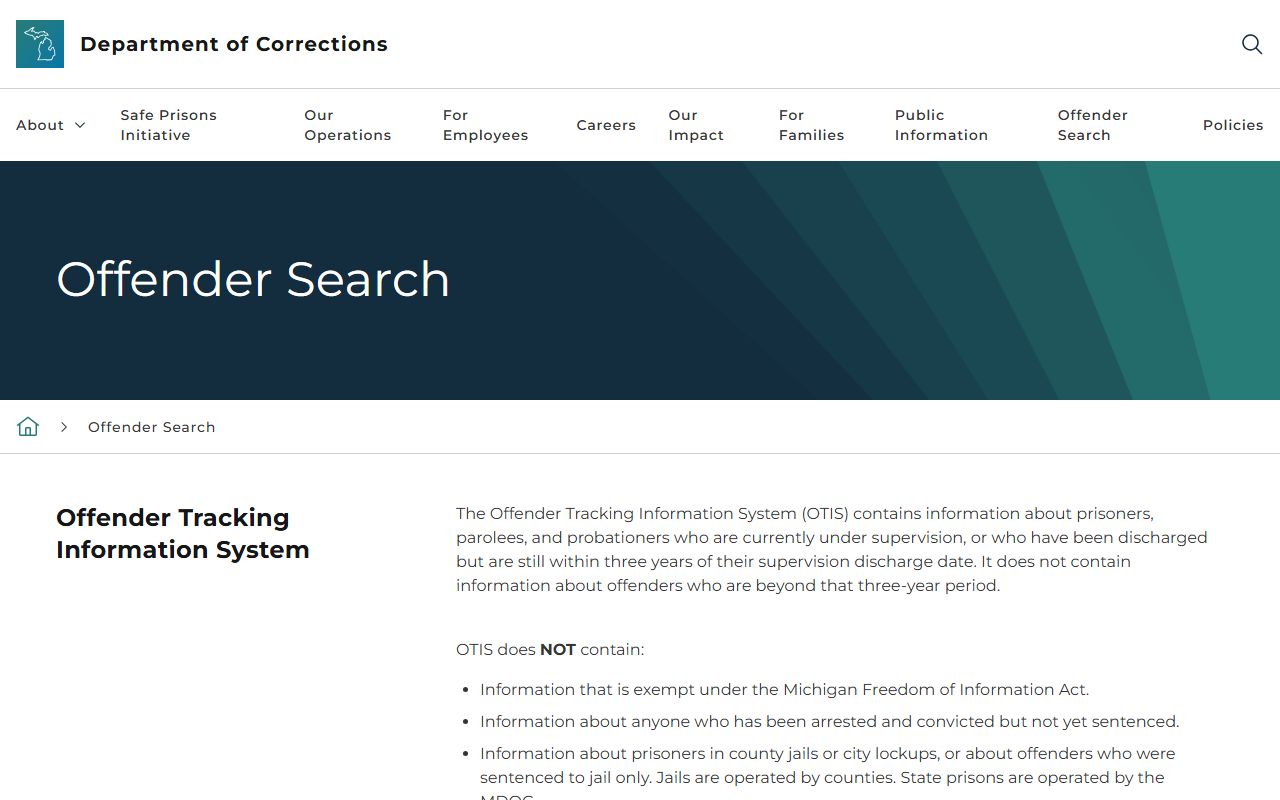
OTIS clearly states that it does not list people held only in a county jail or sentenced to jail alone, so an Ontonagon County jail sentence is confirmed through the Sheriff's Department, not OTIS. The court record remains the authority on the exact sentence the judge ordered.
Sealed vs. Set Aside (Expunged)
Michigan uses the phrase "set aside" for the relief many states call expungement. A sealed record is hidden from public view by a court order but still exists in the file. A set-aside removes an eligible conviction from the public criminal-history record so it no longer appears on an ordinary ICHAT report. Michigan's Clean Slate changes took effect April 11, 2021, and they widened the offense types and the number of felony and misdemeanor convictions that can be set aside. Some records now set aside automatically when eligible, while others still require an application, and the statute at MCL 780.621 lays out the rules.
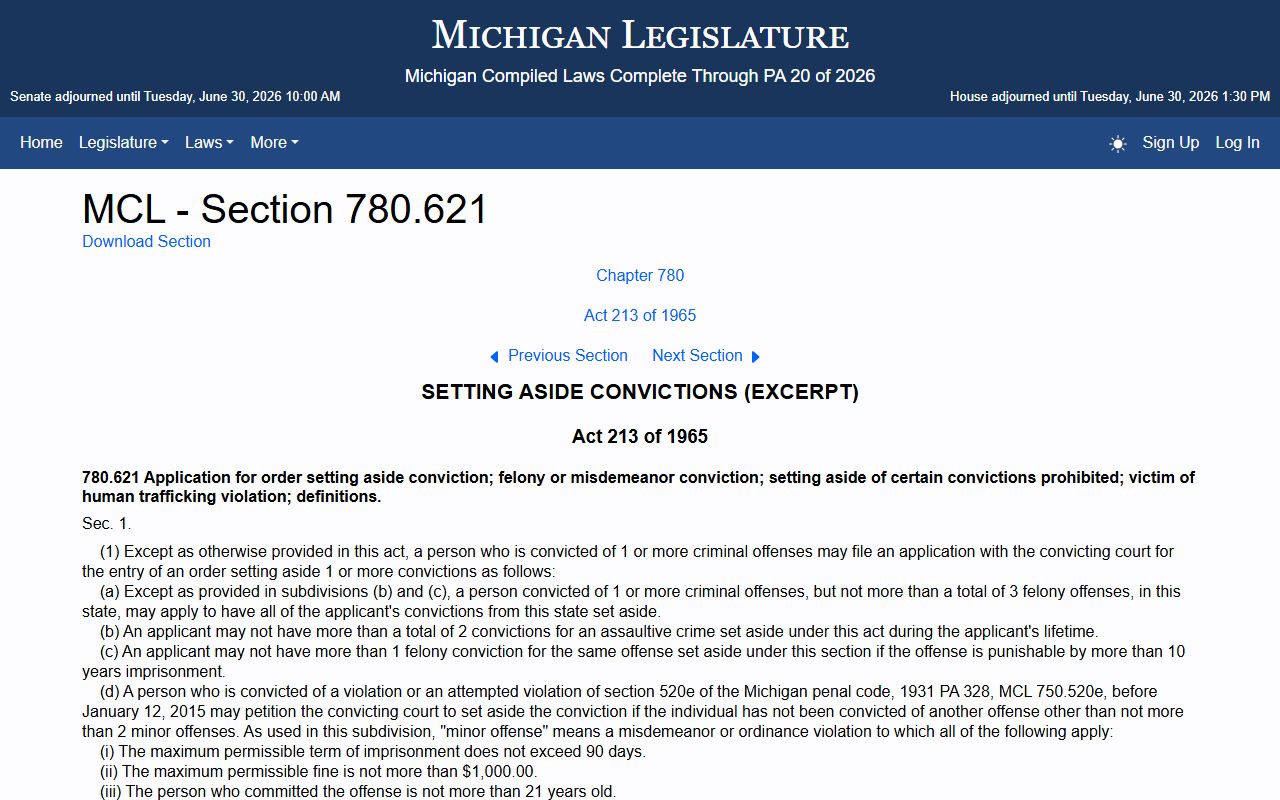
The statute page is the place to confirm which Ontonagon County convictions qualify and whether an application or a hearing is needed. Even after a set-aside, courts and law enforcement may keep nonpublic access as the law allows.
| Sealed | Set Aside (Expunged) | |
|---|---|---|
| Visibility | Hidden from public by court order | Removed from public criminal history |
| Law Enforcement | Limited access retained | Nonpublic access may be retained |
| Michigan Path | Court sealing order in the case | Application or automatic Clean Slate under MCL 780.621 |
| Effect on ICHAT | May still exist in file | No longer shown on public report |
Public Access to Criminal Court Records
Michigan treats court case records as open unless a rule, statute, or sealing order says otherwise. Court sittings are public, and case files can be inspected through the court that owns them. The Michigan Freedom of Information Act favors access to public-body records, but court case files are governed by court rule rather than by FOIA, so the request path for a criminal file runs through the clerk and the court rules, not a FOIA letter. A look at the statute on public court sittings shows how open proceedings are framed in Michigan law.
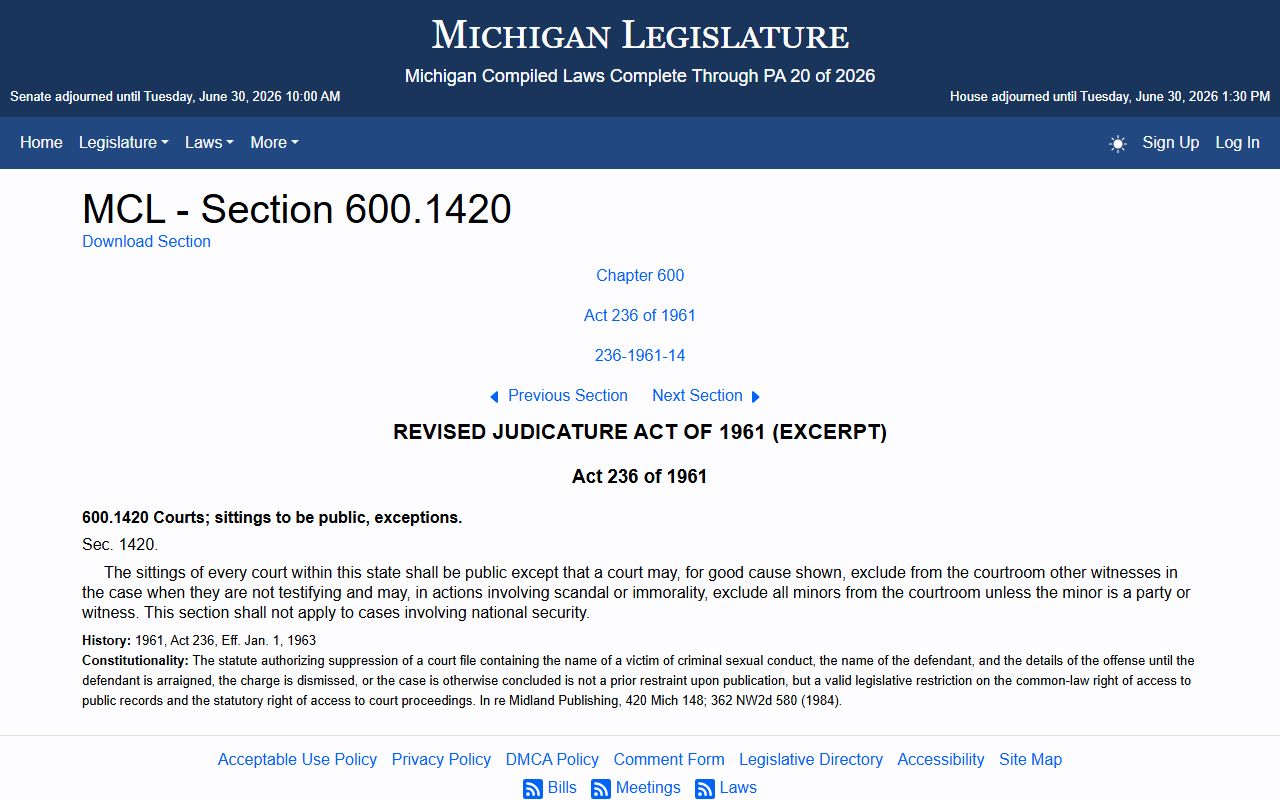
That open-courts principle is why an Ontonagon County criminal case can usually be searched by name and read in the register of actions. For all court records across the county, the broader Ontonagon County court records resources map out each court and clerk.
Key Statutes:
MCL 600.1420 - Court sittings are public unless the court excludes people for good cause or another law requires closure.
MCR 8.119 - Michigan court records are governed by court rule and are public unless the rule, law, or a sealing order restricts access.
MCL 15.231 - Michigan's FOIA policy favors public access to records of public bodies, separate from court-rule access to case files.
The Prosecutor, the Clerk, and Getting Copies
The prosecutor and the clerk play different roles in the criminal court record. The Ontonagon County Prosecuting Attorney, Rudolph Perhalla, reviews police referrals and files the charges that open a case, as the county Prosecutor office page confirms. The prosecutor's office can be reached at 906-884-4155, and it may hold victim and witness contacts, but it is not the clerk and does not issue certified case documents. For a certified judgment or a copy of a filing, contact the court that owns the file. Circuit felony records route through the County Clerk / Register of Deeds at 906-884-4255, where Jerri Corey serves as Chief Deputy for Circuit Court, while misdemeanor and district records route to the 98th District Court at 906-884-2865.
A casual online lookup is not the same as a background check. ICHAT is a repository record, not the live case file, and it leaves out warrants, juvenile matters, local misdemeanors, traffic, federal, tribal, and out-of-state records. Employers and landlords running a formal check must follow the federal Fair Credit Reporting Act, which sets rules a quick criminal-court search does not meet.
Important: This site is a private resource and is not a consumer reporting agency under the FCRA, so its information cannot be used for employment, tenant, credit, or insurance screening.
Restricted Criminal Court Records in Ontonagon County
Not every criminal matter is open to the public. Juvenile case records are limited by MCL 712A.28 and the state nonpublic-record standards, and many are open only to parties, parents, counsel, or people with a court-recognized interest. Records set aside under Clean Slate, sealed by a court order, or held under a diversion program drop out of the ordinary public view. Young adults handled under the Holmes Youthful Trainee Act, known as HYTA, can have their case kept nonpublic when they complete the program, which keeps a qualifying conviction off the public record. Charging papers in an active investigation and search-warrant affidavits may also be withheld until a case moves forward.
These access rules are shaped by statewide court administration, not just local practice. The State Court Administrative Office sets the case-file standards and the nonpublic-record chart that Ontonagon's courts follow. A recent Michigan Courts notice on the Region 4 court administration office shows how Upper Peninsula courts are overseen at the regional level.
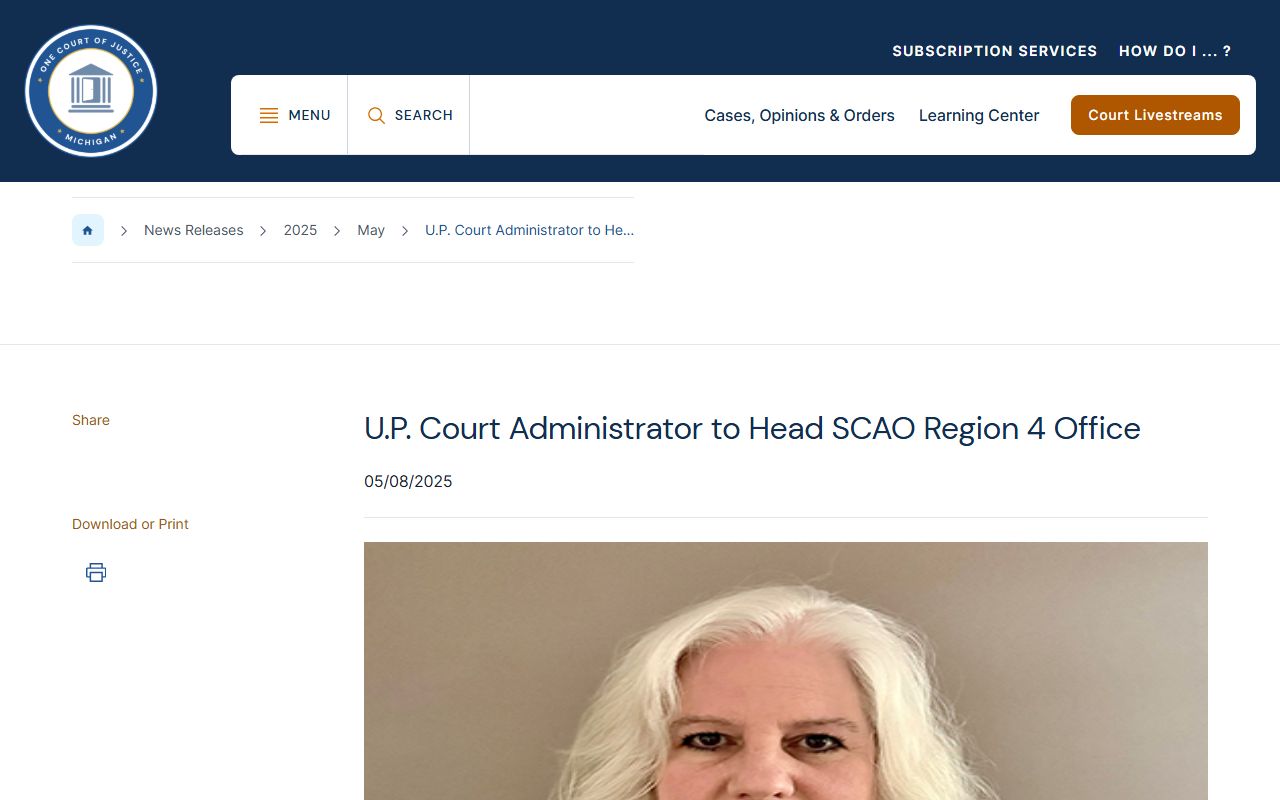
Regional administration is why the standards for restricted records look the same across Upper Peninsula counties, including Ontonagon. When a record is not visible online, that does not always mean it is sealed, so the safest step is to call the 98th District Court or the County Clerk for the 32nd Circuit Court and ask.
Note: A record that is missing from an online search may simply be older or not yet posted, so confirm with the clerk before assuming a case does not exist.